Gondley Consulting
Vet appointment reminders: text and email templates, and when to send them

Ayush Gondley · 7 October 2026 · 6 min read

Most of a clinic's reminders are the same five messages, sent at the right moment for each pet.
Key takeaways
- In AVMA's pet owner survey, 83.4% of owners said they had a regular veterinarian, but only 69.4% had visited a veterinary practice in 2024.
- A small clinic needs five reminder messages: the booking confirmation, the day-before reminder, vaccine and wellness reminders, surgery instructions, and a rebooking message after a missed visit.
- Vaccine reminders should follow each pet's own due dates. AAHA's canine guidelines recommend some core vaccines every three years and leptospirosis every year, and say to follow local laws for rabies.
- Under the FCC's rules, a client can opt out of automated texts by replying "stop" or similar words, and the request must be honored within ten business days.
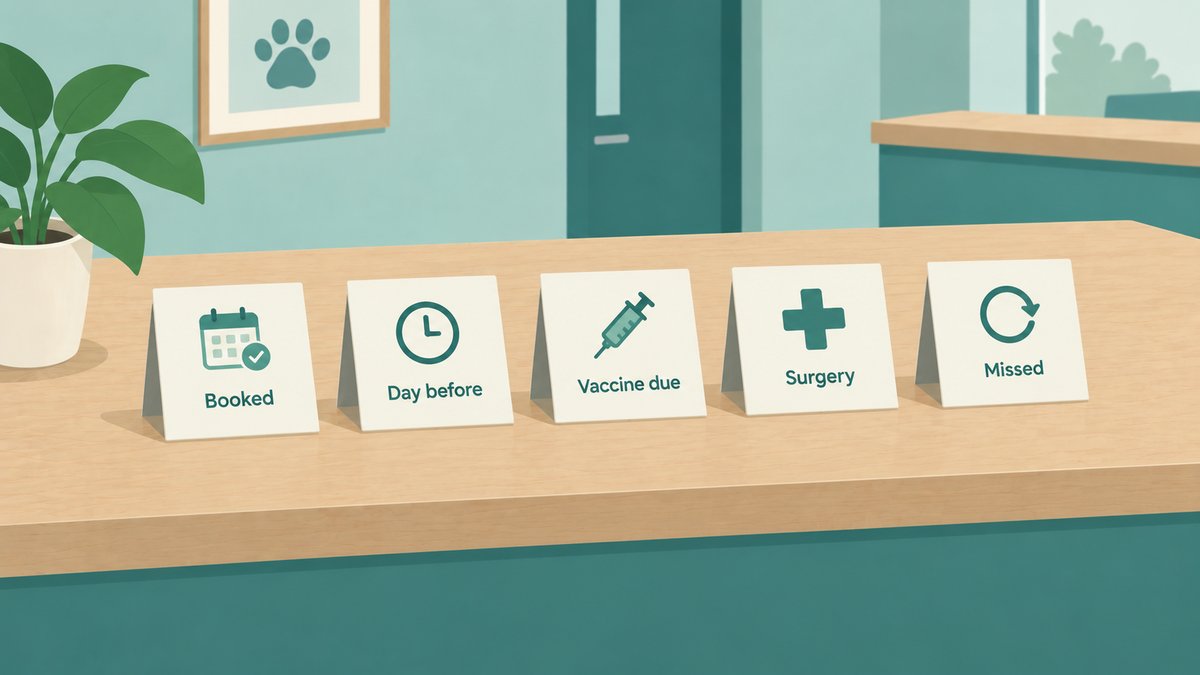
A small vet clinic needs only five reminder messages: a confirmation when the appointment is booked, a reminder the day before, vaccine and wellness reminders driven by each pet's due dates, instructions before a surgery, and a rebooking message after a missed visit. Written once and sent at the right time, they keep clients on schedule without the front desk making the calls.
Why reminders matter in a vet clinic
When AVMA asked pet owners whether they had a regular veterinarian or veterinary practice, 83.4% said they did, but only 69.4% said they had actually visited a veterinary practice in 2024.1
AVMA's advice for closing that gap starts at the desk: book the next appointment before the client leaves, and pair that with an effective reminder system. It also suggests reviewing how often reminders go out, how they are delivered and what they say.2 AVMA's surveys point to other reasons as well: a lack of perceived need and the cost of care are the main reasons some owners spend nothing on veterinary care in a year.2 A reminder will not change either of those. What it does is make sure a client who meant to come back is not simply forgetting.
The five reminders and when to send them
The timings below are our recommendation, not a rule. Adjust them to your clinic and to what your clients tell you works.
- Booking confirmation. As soon as the appointment is booked, with the date, time, vet, address and how to change it.
- Day-before reminder. A text the day before, with a one-letter reply to confirm or to ask for another time. For appointments booked weeks ahead, add an email a few days before.
- Vaccine and wellness reminders. A few weeks before each due date, again on the due date if nothing is booked, and a last one a few weeks after.
- Surgery instructions. Two days before a procedure, with the drop-off time and the food and water instructions the vet has given, then a short text the evening before.
- Rebooking after a miss. The same day, a polite text offering a new time.
The vaccine dates differ from pet to pet. AAHA's 2022 canine vaccination guidelines recommend boosters of the distemper, adenovirus and parvovirus combination vaccine every three years after the first-year booster, and leptospirosis boosters every year. For rabies, they say to follow local laws.3 So the reminder date should come from each pet's own record, not from one yearly mailing to every client.
Templates you can copy
Replace the words in brackets. Keep each message about the pet and the appointment, with no offers mixed in.
Booking confirmation · email, as soon as it is booked
Subject: [Pet]'s appointment on [day, date]
Hi [Client], [Pet]'s appointment with Dr. [Name] is booked for [day, date] at [time] at [Clinic], [address]. If you need to change it, reply to this email or call us on [phone]. — [Clinic]
Day-before reminder · text, the day before
[Clinic]: a reminder that [Pet] sees Dr. [Name] tomorrow, [day], at [time]. Reply C to confirm or R to reschedule. Reply STOP to opt out of texts.
Vaccine due · email or text, a few weeks before the due date
Hi [Client], our records show [Pet] is due for [vaccine] on [date]. You can book online at [link] or call us on [phone]. If [Pet] has already had it somewhere else, reply and let us know so we can update our records. — [Clinic]
Surgery instructions · text, the evening before
[Clinic]: [Pet]'s procedure is tomorrow. Drop-off is at [time]. Please follow the food and water instructions Dr. [Name] gave you: [instructions from the vet]. Questions? Call us on [phone].
Rebooking after a missed visit · text, the same day
[Clinic]: we missed [Pet] today and hope all is well. Reply with a day that suits you and we'll find a new time, or book at [link].
The surgery message carries the vet's instructions for that patient, written in each time. A standard line for every pet would not be safe.
Texting rules to keep in mind
Required by FCC rules: a person can withdraw consent to automated calls and texts in any reasonable way, including by replying "stop", "quit", "end", "revoke", "opt out", "cancel" or "unsubscribe". The request must be honored within ten business days. One text confirming the opt-out is allowed, as long as it contains no marketing.4
Our recommendation: ask each client at check-in which mobile number reminders should go to, and whether they want texts, email or both, and note it in their record. End texts with how to opt out. This is a summary, not legal advice.
What can run by itself
These parts can be set up to run by themselves, inside the practice software, phones and email a clinic already uses:
- Confirmations as soon as an appointment is booked.
- Day-before reminders, where a "C" confirms the visit and an "R" lands with the front desk as a request to reschedule.
- Vaccine and wellness reminders built from each pet's due dates, which stop once an appointment is booked.
- A rebooking text when a pet misses an appointment.
- Opt-outs, recorded the moment a client replies STOP.
What stays with a person
- Surgery instructions. The vet decides them for each patient. The system only delivers them.
- Anything urgent. Calls about a sick or injured pet go to a person, never to an automatic reply.
- Difficult conversations. Clients who are worried, grieving or upset.
- Repeated misses. Deciding what to do about a client who misses again and again.
Count it first
Before changing anything, keep a sheet at the desk for a week. Add a tick for every reminder call made, every no-show and every call spent rebooking. If you tried the five-day tally in our front-desk article, use its "Reminders and no-shows" column. For what to say when a client misses, see our no-show policy article.
Therapy practices have their own version of this in our late-cancellation policy for therapists, and records requests covers the other job that eats front-desk time.
Questions clinics ask
How far ahead should a vet clinic send appointment reminders?
Our recommendation is a confirmation as soon as the appointment is booked and a text the day before. For appointments booked weeks ahead, add an email a few days before.
Should vet reminders go by text or email?
Ask each client and note it in their record. Text suits short, time-sensitive reminders such as the day before; email suits confirmations and vaccine reminders that carry more detail.
How often should vaccine reminders go out?
From each pet's own due dates, not one yearly mailing. AAHA's 2022 canine guidelines recommend the distemper, adenovirus and parvovirus combination every three years after the first-year booster and leptospirosis every year, and say to follow local laws for rabies.
What should we do when a client replies STOP?
Stop the texts. Under the FCC's rules the request must be honored within ten business days, and one confirmation text with no marketing is allowed. Reminders can still go by email if the client wants them.
Sources
- AVMA News, 15 October 2025: Evolving pet owner economics: What data reveal for veterinary teams.
- AVMA@Work blog, 27 February 2025: Chart of the month: From relationships to regular visits.
- American Animal Hospital Association, 2022 AAHA Canine Vaccination Guidelines: Recommendations for core and noncore canine vaccines.
- Code of Federal Regulations, 47 CFR 64.1200(a)(10) to (a)(12), revocation of consent: eCFR, 47 CFR 64.1200.
About the author
Ayush Gondley founded Gondley Consulting, which automates front-desk work for small US medical, therapy and veterinary practices. Before that he was a marine engineer at Maersk, keeping complex systems running at sea. Gondley Consulting on LinkedIn