Gondley Consulting
No-show policy: what to say and how to keep it running

Ayush Gondley · 2 October 2026 · 5 min read

A short, clear policy, sent at booking and applied the same way to everyone, does most of the work.
Key takeaways
- In a December 2025 MGMA poll of 236 practice leaders, no-shows were the top thing they wanted to fix in 2026.
- A useful no-show policy says what counts as a no-show, how patients hear about it, what happens on a first and a repeated miss, and how to rebook.
- If you charge Medicare patients for missed appointments, Medicare requires the same policy and the same amount for every patient. Check your state's Medicaid rules before charging Medicaid patients anything.
- The sending, the reminding and the rebooking can run by themselves. Fees, exceptions and difficult conversations stay with a person.
A no-show policy for a small practice should say what counts as a no-show, how patients are told about it, what happens the first time and the times after, and how a missed visit gets rebooked. Written once and sent at booking, it lets the front desk apply the same rule to everyone without arguing it each time.
Why no-shows keep happening
When MGMA asked 236 medical practice leaders in December 2025 what they most wanted to fix in 2026, no-shows were the top answer (27%), ahead of online scheduling (24%) and phone access (22%).1
Reminders are useful, but they do not remove every reason a patient misses an appointment. In an MGMA poll in August 2026, 32% of medical groups reported higher no-show rates so far in 2026 than in 2025. The practices reporting higher rates described many of the same tactics as practices whose rates held steady or improved, including text and phone reminders, automated messages, confirmation calls, no-show fees and pre-check-in outreach. MGMA notes that these comments "cannot establish which interventions caused rates to rise or fall." The groups seeing increases pointed to patient costs, transportation, work conflicts, and weather and seasonal factors.2 A clear policy will not change any of those either, but it does make the practice's side of the arrangement plain and the same for everyone.
What a no-show policy should say
These six parts are our recommendation. Only the Medicare and Medicaid points further down are rules.
- What counts as a no-show. For example, not arriving within a set number of minutes of the appointment time, chosen by the practice, without having called.
- How patients hear about it. The policy goes out when the appointment is booked, and the patient acknowledges it on the intake form. Therapy practices can say "clients" throughout.
- A first miss and a repeated miss. The policy can treat these differently. You may choose to waive any fee for a patient's first no-show.
- Any fee. Whether to charge one is the practice's choice. If you do, put the amount in the policy and charge it the same way every time.
- Exceptions. Emergencies and other circumstances are decided by a person, never by a rule.
- Rebooking. Say how a patient who missed can book again.
Sample no-show policy
- An appointment is a no-show if the patient does not arrive within ___ minutes of the scheduled time and has not called.
- Please give at least ___ hours' notice to cancel or reschedule.
- A fee of $___ applies to no-shows and to cancellations with less notice than this.
- The fee for a first no-show may be waived at the practice's discretion.
- Emergencies and other circumstances are reviewed by the office manager.
- After a missed appointment, we will contact you to book a new time.
Adapt this sample to your practice, and check your state's rules, including Medicaid's, before charging any fee.
Applying it fairly
Required by Medicare: a practice may charge Medicare patients for missed appointments only if its missed-appointment policy applies equally to all patients, and the amount charged to Medicare patients must be the same as the amount charged to non-Medicare patients. Medicare treats the charge as one for "a missed business opportunity," not for a service.3
Check your state (Medicaid): check your state's Medicaid rules before charging Medicaid patients anything.
Our recommendation for everyone: apply the policy the same way to every patient, and write down every exception and every fee.
What can run by itself
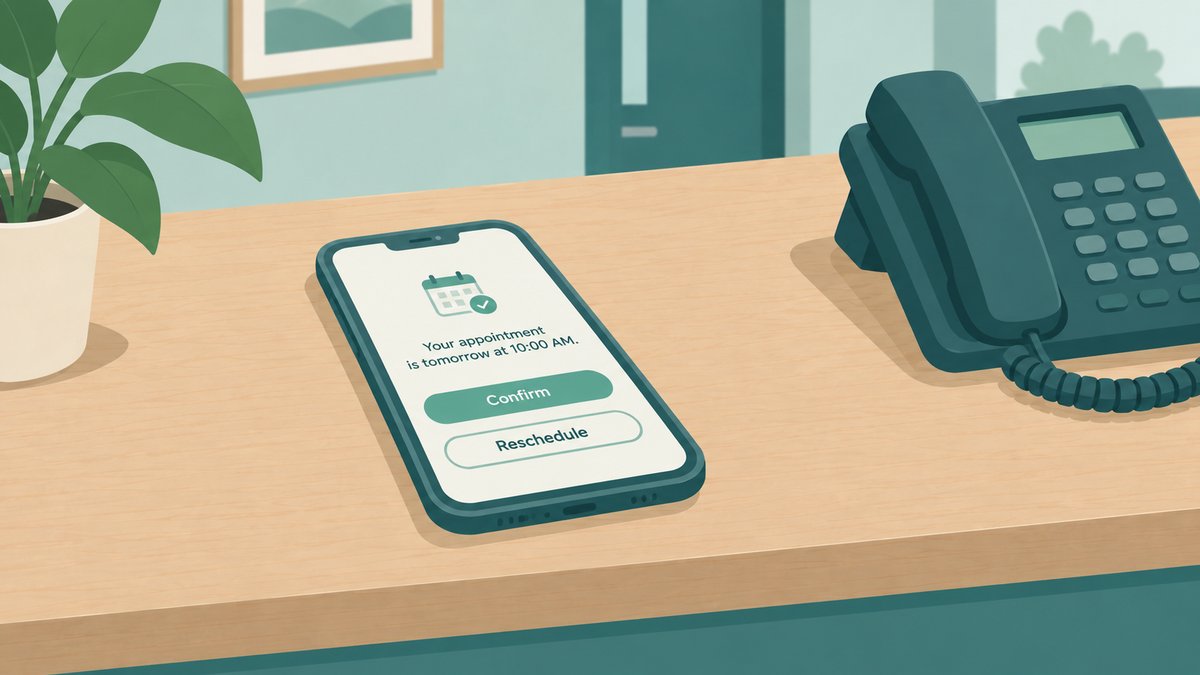
These parts can be set up to run by themselves, inside the scheduler, forms and patient messaging a practice already uses:
- The policy at booking. The booking confirmation carries the policy, and the intake form asks the patient to acknowledge it, so nobody has to remember to mention it.
- Reminders before the visit. A reminder goes out ahead of each appointment, and the patient can reply to confirm or to ask for another time.
- Rebooking after a cancellation or a miss. When a patient cancels or does not arrive, a polite message offers them a new time, so the front desk is not left making the calls.
What stays with a person
- Fees. Deciding whether to charge or waive a fee, including for a patient's first no-show.
- Exceptions. Emergencies and anything the policy did not foresee.
- Conversations. Talking with a patient who is upset, or who needs to explain what happened.
Count it first
If you tried the five-day front-desk tally in our first article, look at its "Reminders and no-shows" column. If you have not, keep a sheet at the desk for a week and add a tick for every no-show and every call spent rebooking one. Do this before and after you introduce the policy, so you can compare your own numbers.
For therapy practices, our late-cancellation policy for therapists covers the same ground with what the APA and ACA ethics codes ask. For vet clinics, vet appointment reminders has the messages to copy. And records requests is the other front-desk job that takes the most chasing.
Questions practices ask
Can we charge Medicare patients a no-show fee?
Yes, if the practice's missed-appointment policy applies equally to all patients and the amount is the same for Medicare and non-Medicare patients. Medicare treats it as a charge for a missed business opportunity, not for a service.3
Should a no-show policy include a fee?
That is the practice's choice. If you charge one, state the amount in the policy and apply it the same way to every patient. For Medicare patients, follow the rule above, and check your state's Medicaid rules before charging Medicaid patients anything.
How do we tell patients about the policy?
Our recommendation is to send it with the booking confirmation and ask for an acknowledgement on the intake form, so every patient has seen it before their first visit.
What should we do when a patient has an emergency?
Our recommendation is to leave emergencies to a person. The office manager decides case by case, and the decision is written down.
Sources
- MGMA Stat poll, 9 December 2025 (236 practice leaders): Patient access priorities for 2026.
- MGMA Stat poll, 11 August 2026 (190 responses): About 1 in 3 medical groups see higher no-shows in 2026.
- Centers for Medicare & Medicaid Services, Medicare Claims Processing Manual, chapter 1, section 30.3.13, "Charges for Missed Appointments": CMS manual (PDF).
About the author
Ayush Gondley founded Gondley Consulting, which automates front-desk work for small US medical, therapy and veterinary practices. Before that he was a marine engineer at Maersk, keeping complex systems running at sea. Gondley Consulting on LinkedIn