Gondley Consulting
Late-cancellation and no-show policy for therapists: wording you can copy

Ayush Gondley · 9 October 2026 · 6 min read

Agreed at the start, in writing, and applied the same way to every client.
Key takeaways
- The APA and ACA ethics codes both ask therapists to agree fees and billing arrangements with clients early, as part of informed consent. A late-cancellation fee belongs in that agreement.
- A useful policy says how much notice is needed, what counts as a late cancellation or a no-show, the fee, how emergencies are handled, and how to rebook.
- If you charge Medicare clients for missed sessions, Medicare requires the same policy and the same amount for every client. Check your state's Medicaid rules before charging Medicaid clients anything.
- Reminders, the policy at intake and rebooking can run by themselves. Waiving a fee and talking it through with a client stay with the therapist.
A therapy practice's late-cancellation policy should say how much notice a client must give, what counts as a late cancellation or a no-show, what the fee is, how emergencies are handled, and how to rebook. Agreed in writing at intake and repeated in every reminder, it lets the practice apply the same rule to every client without having to argue it each time.
What the ethics codes ask
The APA Ethics Code says psychologists and the people they serve should reach "an agreement specifying compensation and billing arrangements" as early as is feasible, and that fee practices must be consistent with law.1 Its standard on informed consent to therapy lists fees among the things clients are told about early in the relationship.1
The ACA Code of Ethics asks counselors to inform clients about "fees and billing arrangements, including procedures for nonpayment of fees" as part of informed consent. It also says counselors consider a client's financial situation when setting fees, and may adjust them, when legally permissible, where the usual fee would cause undue hardship.2
So a late-cancellation fee that is explained at intake, agreed in writing, and applied as written sits comfortably within both codes. A fee a client first hears about after missing a session does not.
What the policy should say
These parts are our recommendation. Only the Medicare and Medicaid points further down are rules.
- The notice period. How many hours before a session a client can cancel or reschedule without a fee. Choose enough notice to offer the time to someone else, for example 24 or 48 hours.
- What counts as a late cancellation, and what counts as a no-show. For telehealth, say how many minutes after the start time a session counts as missed.
- The fee. Whether it is the full session fee or part of it, and that it is charged the same way every time.
- How it is paid. If you keep a card on file for this, say so and get the client's written authorization.
- Emergencies and illness. Decided by the therapist, case by case, and written down.
- Rebooking. How a client who missed a session books the next one.
Sample policy · in the intake paperwork, signed at the first session
Your session time is reserved for you. If you need to cancel or reschedule, please let us know at least [24] hours before your session.
Sessions canceled with less notice, and sessions missed without notice, are charged at [the full session fee / $___]. For telehealth sessions, a session counts as missed if you have not joined within [15] minutes of the start time.
This fee is not billed to insurance; it is charged to you directly[, using the card you have authorized us to keep on file].
Emergencies and illness are considered case by case. If something unexpected happens, please contact us as soon as you can.
After a missed session, we will contact you to book your next one.
Adapt this sample to your practice, and check your state's rules, including Medicaid's, before charging any fee.
Medicare, Medicaid and insurance
Required by Medicare: a practice may charge Medicare patients for missed appointments only if its missed-appointment policy applies equally to all patients, and the amount charged to Medicare patients must be the same as the amount charged to non-Medicare patients. Medicare treats the charge as one for "a missed business opportunity," not for a service.3
Check your state (Medicaid): check your state's Medicaid rules before charging Medicaid clients anything.
Our recommendation for insured clients: a missed session is not a session, so the fee is charged to the client, not billed to the insurer. Check your payer contracts for anything they say about missed-appointment charges.

Messages you can copy
The policy only works if clients see it before it matters. These carry it at the moments it is needed.
Session reminder · text, the day before
[Practice]: a reminder of your session with [Therapist] tomorrow, [day], at [time]. If you need to reschedule, please reply R before [time] tomorrow, [24] hours before your session. Reply C to confirm. Reply STOP to opt out of texts.
After a late cancellation · email, the same day
Hi [Client], thanks for letting us know about [day]'s session. As it was canceled with less than [24] hours' notice, the late-cancellation fee of [amount] applies, as set out in the policy you signed at intake. If something serious happened, just reply and [Therapist] will look at it. Here is a link to book your next session: [link]. — [Practice]
After a missed session · text, the same day
[Practice]: we missed you at today's session and hope you're okay. Reply with a day that suits you and we'll find a new time, or book at [link].
Keep the first message after a miss about the client, not the fee. The fee can follow in a separate, plain message, or in the next statement.
What can run by itself
These parts can be set up to run by themselves, inside the practice software, forms and messaging a practice already uses:
- The policy at intake. The intake forms carry the policy and the client signs it, so nobody has to remember to bring it up.
- Reminders that state the notice period and take a one-letter reply to confirm or reschedule.
- Rebooking after a cancellation or a missed session.
- A log of late cancellations and no-shows, so the practice can see how often they happen.
What stays with the therapist
- Waiving or charging the fee. Including for illness, emergencies and a client's first late cancellation.
- The conversation. A pattern of missed sessions can be a clinical matter as much as a billing one.
- Hardship. Adjusting fees for a client who cannot afford them, as the ACA code allows.
Count it first
For two weeks, keep a tick list: every late cancellation, every no-show, and every hour that went unfilled because of one. If you tried the tally in our front-desk article, use its "Reminders and no-shows" column. It gives you a number to compare once the policy and the reminders are in place. For practices that are not therapy-only, our general no-show policy article covers the same ground for medical offices.
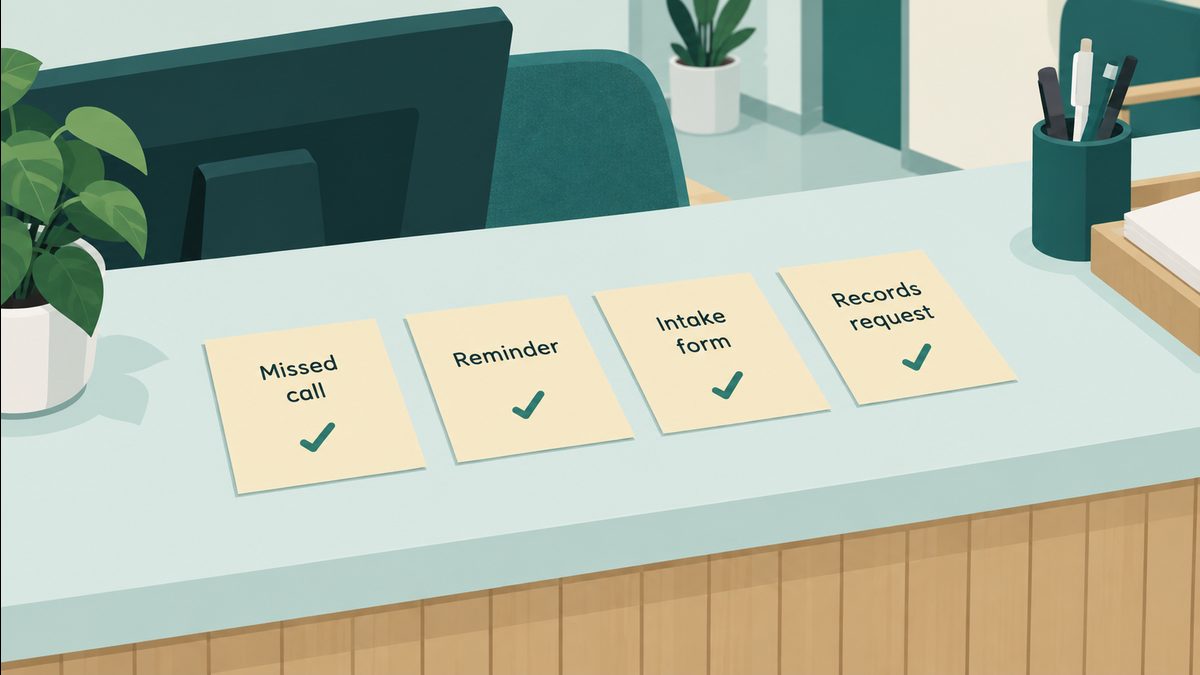
Missed sessions are one of four front-desk jobs worth automating. Another that comes up often in therapy practices is records requests, where psychotherapy notes sit outside the patient's right of access, and our vet reminders article shows the same reminder messages built for a clinic.
Questions therapists ask
Can a therapist charge for a late cancellation?
That is the practice's choice. The APA and ACA ethics codes both ask that fees and billing arrangements are agreed with clients early, as part of informed consent, so a late-cancellation fee should be in the written agreement before it is ever charged.
Can we charge Medicare clients for a missed session?
Yes, if the missed-appointment policy applies equally to all clients and the amount is the same for Medicare and non-Medicare clients. Medicare treats it as a charge for a missed business opportunity, not for a service.
How much notice should a cancellation policy ask for?
Our recommendation is enough notice to offer the time to another client, for example 24 or 48 hours.
Should the late-cancellation fee be billed to insurance?
Our recommendation is no: a missed session is not a session, so the fee is charged to the client. Check your payer contracts, and for Medicare follow the rule above.
Sources
- American Psychological Association, Ethical Principles of Psychologists and Code of Conduct (effective 2003, amended 2010 and 2017), Standards 6.04 (Fees and Financial Arrangements) and 10.01 (Informed Consent to Therapy).
- American Counseling Association, 2014 ACA Code of Ethics (PDF), sections A.2.b, A.10.c and A.10.d.
- Centers for Medicare & Medicaid Services, Medicare Claims Processing Manual, chapter 1, section 30.3.13, "Charges for Missed Appointments": CMS manual (PDF).
About the author
Ayush Gondley founded Gondley Consulting, which automates front-desk work for small US medical, therapy and veterinary practices. Before that he was a marine engineer at Maersk, keeping complex systems running at sea. Gondley Consulting on LinkedIn